

Yvonne Lewis Langlois
“Textiles and clothes are almost 100 per cent reusable and recyclable and yet the volume of textile going into landfills has increased 40 per cent in one decade. The fashion industry is responsible for around 10 per cent of the climate change crisis.” This quote from the book The Conscious Closet emphasizes the impact that the fashion industry has on our environment. Author Elizabeth L. Cline explores the environmental impact of new clothes and guides us to creating a more ethical wardrobe.
Environmentally friendly shoppers may find these statistics daunting, but solutions do exist. ‘There’s an app for that’ — actually, there are many apps. Check out the website Good On You and its app for help identifying brands that care about the environment and their workers. Its motto, “Wear the change you want to see,” speaks volumes. Smartphone apps like Stylebook and Cladwell can help you reorganize your closet to help you get better use out of the clothes that you already own; and for the eco-friendly fashion lover, the vintage clothing store is a must.
Such stores are all about being eco-friendly, and Ormstown boasts two establishments, both on Lambton St., that offer customers an alternative to new clothing. The Rustic Home opened its doors in September, while Lee’s Cloake-Room has occupied its corner location for nine years. Store owner Lee Cloake emphasizes that his store carries designer vintage clothing. If you would like to see what a $2,000 Armani suit looks like, this is your place.
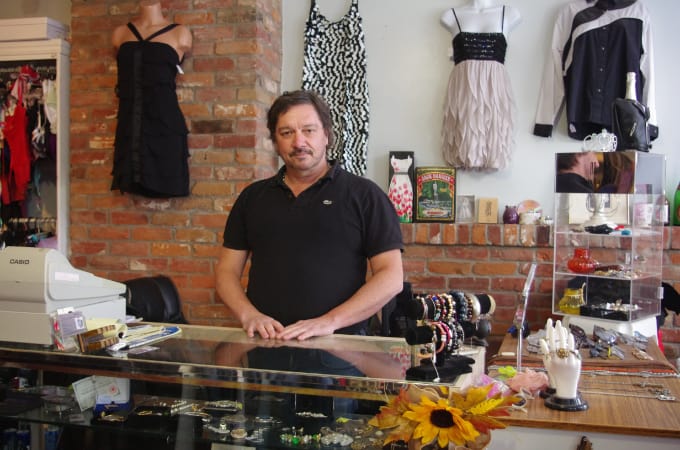
Besides welcoming walk-in customers, Cloake posts on Facebook and also caters to private clients searching for specific items. The store carries “lots of expensive stuff, designer stuff,” he says. Having been in this business for 15 years, Cloake is in tune with what his customers are searching for. Many of his clients travel from the city, largely “People [who] are looking for a label. It’s all about the look, not about the practicality.” Sixty per cent of Lee’s customers are 40 and under, but he sees the recycling aspect of shopping at vintage clothing stores as more of an “urban thing … The green trend is not so much in the country,” he says. On the other hand, “Farmers will come and pick up a slightly used jacket that will become a barn jacket,” he adds. “Country people are more practical.”
Lee’s Cloake-Room also accepts clothes on consignment. He has regular clients in Westmount who open their closets for regular purges. Sometimes it’s “stuff they have never touched for five years, still with the tags on!” he exclaims. Local people also bring in items.
His vintage store is hard to miss as two mannequins, affectionately known as “The Ladies of Lambton,” stand proudly outside the store sporting an array of eye-catching outfits. Cloake observes: “I’ve got 10 seconds to capture people’s imaginations before they turn the corner and I make sure that they see them. My mannequins sell a lot of clothing!”
To avoid contributing to landfills, when clothing does not sell Cloake distributes some of it to local churches and delivers the rest to the Salvation Army in Montreal.
Most retail businesses feel the dip in sales as the winter months drag on but Cloake is optimistic. He sees many new faces from the new developments in Huntingdon and Howick. He notes that there is “a new breed of hippie who wants to invest in a better quality item that will last longer.” Less clothing thrown away equals less impact on the environment. Vintage clothing stores offer shoppers an opportunity to feel good not only about how they look, but also about how their purchases impact the planet. As The Conscious Closet’s author puts it, “Buy better, buy less.”