

Denis Bouchard
Translated by Sarah C. Fraser
My dear Gabriel,
The day was bathed in a soft, warm light and I held on to my father’s hand very, very tightly. We were walking to the train station, which was three doors down from our house. I was very excited, but I was also a little apprehensive; I’d seen the big locomotive before, and it was very big! And I’d certainly heard it rumble far away down the tracks. I was three years old, the same age as you are right now. We were going to the station to pick up my aunt, who was arriving from Montreal. Montreal was a distant and mysterious world to me that the adults only talked about once in a while. The Hemmingford train station was a very big building, made of wood and painted a faded red, that extended along the railroad tracks. Papa and I followed the tracks in front of the freight shed with a large sliding door and entered the waiting room, just before the station master’s house.
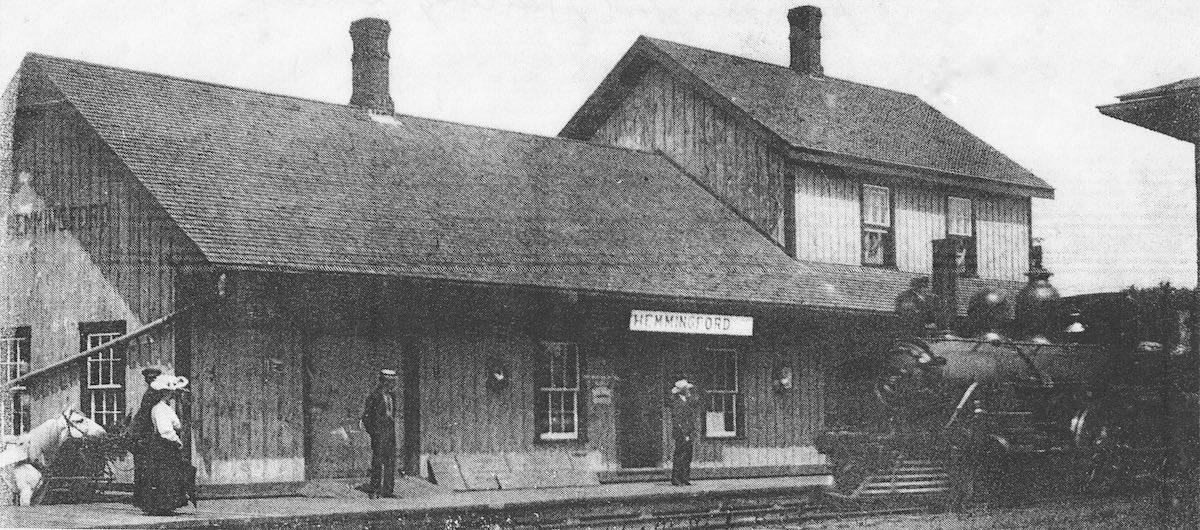
There were already a few others waiting for the train, and we sat down on a big wooden bench. A clattering noise came from the ticket counter where the station master was standing. He saw that I was curious and he motioned to me to come and see. My Papa lifted me high into his arms to put me at the same height as the ticket counter, and I saw a very strange, small device that looked like a tiny see-saw connected to two wires. It swung and tapped on a piece of metal and that was what was making the strange sounds. When it stopped, the station master put his finger on the telegraph (the tiny device) which produced long and short clicks. He explained to me that these clicks were in fact the letters of the alphabet that made it possible to write messages in “Morse code.”
The earth began to shake and with a thunderous rumbling, the enormous locomotive slowly advanced in front of the window. The huge metal wheels screeched against the tracks in a high-pitched squeal. The locomotive was pulling two cars, which came to halt in front of us. When I went out with Papa, I also saw the caboose, a sort of little cabin on wheels at the back of the train for the train workers.
While Papa was helping my Tante Jeanne step down from the train with her suitcase, I was watching the men unload goods through the big sliding door on the other car. There were large flat boxes with little round holes on the sides and top, which piqued my interest because I could hear chirping sounds coming from within. I had just enough time to notice the little yellow feathers peeping through the holes when Papa took me by the hand to go back home. Later, when I was a big boy, 8 or 9 years old, I was always running off to the station with my friends when we heard the train coming. We were there to greet the new chicks, and we’d hurry to put our fingers through the small holes to be pecked by the little chicks before the farmers arrived to carry off their boxes.
The trains are long gone now, but you can still make out the old route. The bike path near the recreation centre follows the same curve as the old train tracks, stretching far to the north, tucked in between the trees.