

Iris Delagrange
Translated by Sarah Rennie
It’s official: as of June 1, clients can reschedule appointments with massage therapists, osteopaths, and physiotherapists. But what exactly does the long-awaited resumption of such services look like? Caught between relief — after a complete work stoppage for two-and-a-half-months — and nervousness, physical therapists find their daily professional practice is not the same as before.
The sudden closure of all services in March took Melissa Moore, a massage therapist practising in Huntingdon for 15 years, by surprise. “I wasn’t following the news, but my partner was. I found out from him that the number of cases was increasing and the virus was spreading,” she says. At that time, there was still little known about the virus and how it was transmitted. It was affecting people in China and those returning from travelling. “It wasn’t until I got a call from my children’s daycare saying they were closing for at least two weeks that I understood,” she adds. It was at this time that Moore began to cancel her appointments, preferring not to risk the health of her vulnerable clients or her small family.
For Caroline Rolland, an osteopath at the Centre Physio Multi-services in Ormstown and Saint-Louis-de-Gonzague, the situation was much the same. The situation became real “on March 13, with the closure of my son’s school,” she says. Appointments were cancelled; however, she told her clients to contact her in case of an emergency.
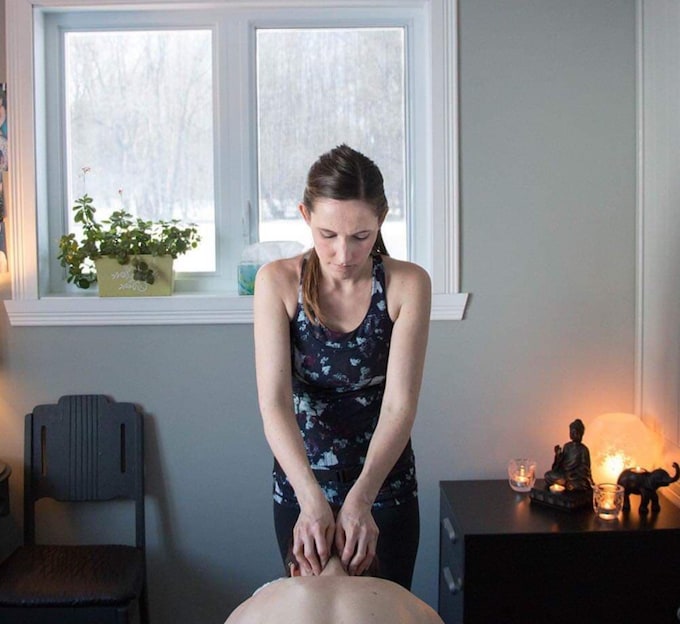
Physical therapy at a distance is complicated. “I was able to give people who needed it some exercises to do to manage their pain,” says Moore, who specializes in MAT (Muscle Activation Techniques).
The two self-employed women also applied for the Canadian Emergency Response Benefit, which they were able to receive without major delays. “I was able to organize quickly, I’m used to it,” Rolland says with a smile.
Complex return with strict guidelines
Now that the return to work is officially underway, physical therapists must comply with strict public health measures prescribed by the government (Ministry of Health and CNESST).
The wearing of a mask is mandatory for both the client and the therapist. The therapist must also wear a visor or goggles, as well as a disposable gown that will have to be changed between each client. Self-employed therapists such as Moore and Rolland must purchase their own personal protective equipment, which entails additional costs.
Then there is the issue of gloves. Moore says she has to wear them while working on clients, which is uncomfortable (the gloves get loose and slippery) and negates the soothing effect that a relaxing massage can have. And the equipment is expensive and hard to find, she says. “Before the pandemic, a box of 100 masks cost about $6. I paid $40 for 100 for the ones I am using.”
Rolland says she was not given the directive to use gloves, and can massage without wearing them. “It’s up to each of us individually to adapt, and quickly! It won’t be perfect right away,” she explains. So long as the most important rules are clear, such as disinfecting massage tables, hand-washing and other sanitary measures that were already in place prior to this crisis, therapists will adjust their procedures as they go along.
Certainly, caution is called for and it is generally accepted that it is best to do more than not enough.
The future of the profession
Beyond health and hygiene measures, it is important to raise the following point: physical therapy, whatever its form and name, is essential for many but also a luxury for some.
Since the start of the pandemic, Moore has been concerned about her clients and whether they will be able to continue coming for therapy.
“For some it is an essential expense; for others — and I fully understand this — it is a secondary expense. If the economy is not going well, some of my clients may not come back as often, if at all, which puts me in a precarious situation,” she says. There are also some who may not return because they’re afraid to leave their homes.
“I have confidence,” says Rolland. “If not in this pure and strict format, I’ll adapt.” Pandemic or not, chronic pain and physical discomforts simply don’t take a break.