

VOICES FROM THE VALLEY: COPING WITH THE PANDEMIC
Holly Dressel
The Chateauguay Valley’s inside voice on working in some of the worst of the CHSLDs at the height of the pandemic makes it pretty clear why so many died in these facilities, and also why we all still have to be very careful. Dale Langille is a financial analyst living in Hemmingford; but 12 years ago, he got certified as a licensed practical nurse and worked in the health-care system until 2016. He had invested a lot of time gaining the skills and loved the work, but left four years ago because of how nurses are paid and scheduled.
“It’s a load of malarkey that you can have any work stability,” he says. “The way it’s set up, seven days on and 14 off, nurses and orderlies only get about eight to 10 days a month of work they can count on. The rest is all ‘on-call.’ ” That means that as they’re getting their kids ready for the beach or going to bed exhausted, the phone will ring with what may be their only chance to pick up the extra hours they’ll need to survive that month. At a wage not much over $20 an hour (around $25 in public, $20 in private sectors) very few people can survive without working these disruptive, unpredictable and exhausting shifts. Not only that, they’re called to a multitude of hospitals or long-term care homes, which is one of the main reasons why so many vulnerable old people caught the virus: it was transported from one facility to another by workers who had no choice but to move around if they wanted to earn enough to survive.
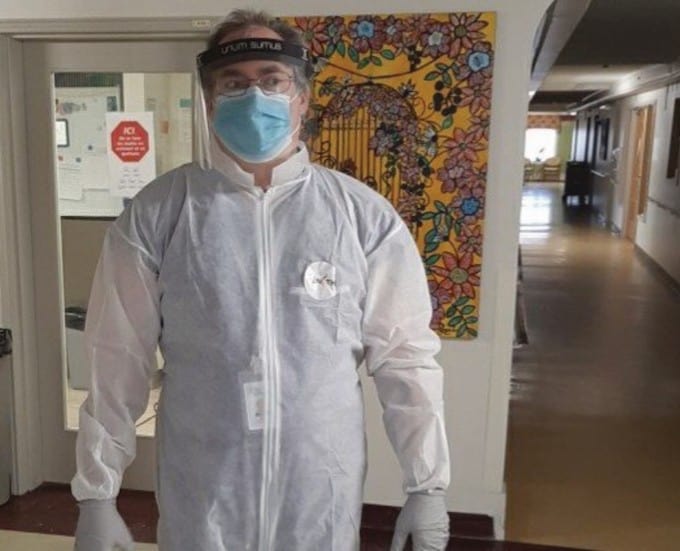
“Almost no one can get a stable position in just one facility, and even then it’s still only seven out of 14 days. It’s the way they set up the system years ago,” Langille says. It happened “because of nurses not wanting a regular five-day week. It’s such a stressful job that a normal 40-hour week is too much.” But seven out of 14 isn’t enough, and at such pay. These days, “because of lack of employees and so many off sick or quarantined, there’s plenty of overtime. But that’ll change when they go back to regular routines.”
Knowing all this, and having already changed jobs, why did Dale Langille put himself in harm’s way when the pandemic hit back in March? Between then and June, he spent 10 weeks working in this crazy way, shunted between facilities as they needed people, both as a practical nurse and as an orderly. He had to live in hotels so he wouldn’t bring the virus home to his family; and he eventually caught it. He doesn’t seem to regret any of it.
Langille says his financial advisory business was largely shuttered by the lockdown, and although he could have collected the federal stipend, “I couldn’t see myself sitting at home, taking the CERB when I had the skills to help.” He worked in a number of facilities, all overrun with people sick or dying with the virus. The last place he was at, the CHSLD St-Jude in Laval, was one of the worst he worked at, he says. “The floor I was on, 65 beds, it was full before COVID. By the first week of May it was down to 54 people, then down to 37. They lost half their residents.”
Because he’s sent in by an agency, like so many other “angels of mercy,” it’s not made clear whether each place is privately or publicly owned, and he’s not sure about St-Jude. (Nor does the website of its parent company make clear whether it’s a private or public institution.) Because of pay scale and need, by then he was working as an orderly, “who are really doing the hardest work, even more than nurses!” he says. “We got almost no days off or time to relax; If you got even one day, you’d come back and two or three of the people you cared for had died.” At the end, although 37 survived, “all but two got it out of 65 on the floor.” Langille says sadly, “you have to understand, these were all people very sick already, having to be changed and fed. But a number can still talk and relate to others, I’d go sit with them when I had some free time. It was … you become friends. It’s really hard to just see them go.” The months they had spent without their loved ones “were harder on some; one man thought I was his brother; another his son.” Of course, “I played into that, yes mom (or dad), I’m here, would give them a hug.”
Here’s the kicker. When it calmed down enough that he felt he could leave St-Jude and go home, Langille decided to get tested for the virus. “Nobody told me to or required it,” he says. And in fact, health care workers are not being tested regularly or reliably for this virus, however much they’re exposed. He felt fine but, not surprisingly given all his exposure, he tested positive; so on top of three months away from his family, he had to spend the next two weeks quarantined in his basement. Fortunately, he never got actively sick. Langille says, “If I hadn’t decided to get tested, how many people would have gotten infected from me not knowing and being around them! Our system is very flawed.”
Because of this experience (and because he’s a health care professional), Langille is pro masks in public places. “I don’t want people getting sick. I think out here in the country we think we have more space, but like me, people could have it without knowing and be spreading it! In our public places, no one is masking.” We might do that, if only to show we’re thinking of all the people who have died, and all the people like Dale Langille, who have gone beyond the pale to assist and protect us.