

Iris Delagrange
Translated by Sarah Rennie
It’s no secret that the Valley is home to an abundant and diverse array of wildlife. Birds in large numbers, insects, mammals and reptiles are a delight for nature lovers. It should come as no surprise that bats are also a well-known resident of this region.
Bats are present in greater numbers in the sandy and perhaps less cultivated areas of Cazaville, Dundee and Saint-Anicet, where food is plentiful and the vegetation offers enough protection for them.
It is only natural that Sylvain Gascon and other farmers in the region would turn to these predators, which have long been considered a nuisance, in an attempt to respond to an emerging problem: the western bean cutworm, which has been ravaging corn crops. The larva of this species of moth attacks field crops, becoming a scourge for farmers since it first began to spread east into southern Quebec. Endemic to the western United States, the western bean cutworm was not present in our region until a few years ago. Scientists believe the insect could have spread by wind or by the warmer temperatures we have been experiencing in recent years. The insect is also now present in southern Ontario as well.
Cohabiting with bats
Since most farmers and residents who have dealt with bats have solved the ‘problem’ by patching holes in walls and roofs of their barns and homes (bats like to nest where heat accumulates), it was necessary to think of a way to bring the small flying mammals back, while being able to cohabitate with them in a harmonious way.
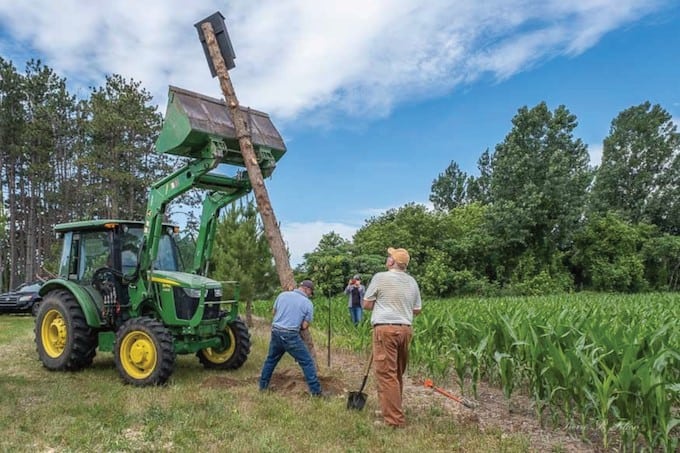
Sylvie Thibaudeau, an agronomist with the Club Agroalimentaire du Bassin LaGuerre, came up with the idea to strategically place bat homes near locations where bats would naturally come to breed, in an effort to encourage them to settle and have their pups.
“Normally, we would have set up these homes in April, but we waited a little because of COVID,” explains Gascon, a retired farmer who, along with other colleagues, has donated his time to the project.
A total of six bat homes have been installed on one farmer’s land. The houses must be installed according to very precise guidelines in order to maximize the chances of attracting the animals. For example, they must be placed six to nine metres from the first branches of a forest edge or wooded lot, and four to six metres from the ground. The houses should always be placed close to a water source and be facing south for better sun exposure. “It can take up to two years before bats will settle. If it hasn’t worked by then, the bat houses should be relocated,” Gascon says.
The project could be described as a community, agricultural and agro-environmental project. If it proves to be a success, more bat houses could be set up in the area, both by farmers and other residents. The demand is already there, confirms Gascon. “There are at least six other farmers who are interested, and I have received requests from citizens. I am sending them the plans for the bat houses.”
At the same time, it is important to remain cautious around bats and to never touch them, as even though they are easily observed, they can be carriers of different diseases, such as rabies.
In the fight against the cutworm however, they are valuable allies. In other wooded and sandy areas of the Valley, such as on the 1st Concession in Hinchinbrooke, bats can help regulate mosquito populations, especially around swampy areas and water. If you have bats in your home, look into different ways to live harmoniously with them.