Hugh Maynard
Publisher
Well, we made it through the first year of The Gleaner’s relaunch and the future looks promising. The revived Gleaner has been a team effort from the beginning — a volunteer board, a dedicated staff, loyal advertisers and a very supportive community. These are the key ingredients for successful community initiatives, and The Gleaner is no exception.
If relaunching a community newspaper in the current media context wasn’t tough enough, The Gleaner was barely out of the starting block when, like everyone else, the paper was left staring the lion right in the eyes — the COVID lion, to be exact.
It’s positive and highlights what’s going on in the Valley!”
Advertising and retail sales evaporated as the economy came to an abrupt halt in the spring of 2020 and The Gleaner only made it through thanks to some very loyal advertisers and government contributions — the ‘Blue ads’ from the government of Quebec, and various job assistance, internship and support grants from the federal government. Along with our great subscriber base: thank you all!
The effort and experience of 2020, despite the uncertainty generated by COVID, showed that The Gleaner is viable as a community newspaper so, in the fall of 2020, we ran a reader survey to see what everyone thought about the ‘new’ Gleaner.
The results were overwhelmingly positive while highlighting a few areas where there is still work to be done. Read on for a few insights about The Gleaner’s readership and the plans for the future.
Who Are The Gleaner’s Readers?
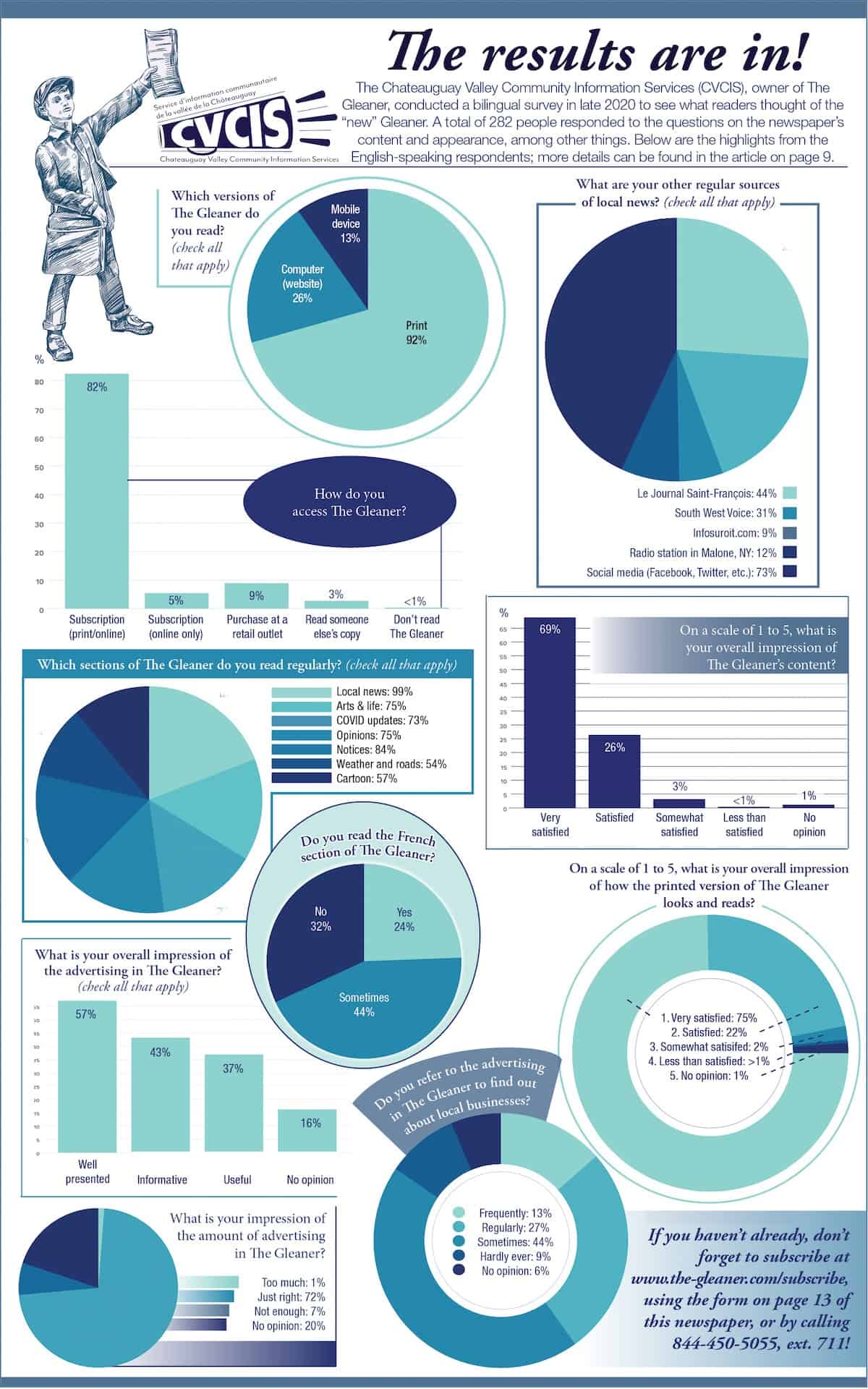
The survey was conducted in English and French with 282 respondents, which is equivalent to approximately 15 per cent of The Gleaner’s subscription and retail base. While the vast majority of respondents were English-speaking (N=262), the overall impression of the paper was similar for English and French readers, with, of course, a few nuances.
The survey results indicated that The Gleaner’s main readers are women, 55 years of age and older, and they read the print edition. No doubt their husbands or partners also read The Gleaner but the women are the ones who responded to the survey.
“It is local news, which is hard to access elsewhere.”
Half of readers live in the Howick-Ormstown-Huntingdon corridor, with additional numbers in the south and west of The Valley (Franklin-Hinchinbrooke-Elgin), and to the east in Havelock and Hemmingford. Almost 10 per cent of subscribers live outside of the region, no doubt those who used to live in the area and want to keep in touch.
What Do They Like?
Almost all (97 per cent!) of the readers who responded like The Gleaner’s format, the way it looks and reads, and 93 per cent are satisfied or very satisfied with the paper’s content. A commitment was made right from the beginning to produce a publication with quality local content and the survey indicates that this goal has been achieved.
Although the number of respondents who were satisfied or very satisfied with the website of The Gleaner was lower (53 per cent), this was because many more respondents selected “no opinion” as their answer, indicating that many fewer subscribers are looking at the website. Generally, comments about the website were otherwise positive.
“What I like about The Gleaner is the stories about the locals, from Hemmingford to Dundee.”
Readers also responded favourably to the advertising in the paper, with just over half saying that the advertising is well presented, three-quarters noting that the quantity of advertisements is “just right,” and 40 per cent answering that they refer to advertisements in The Gleaner on a frequent or regular basis.
A Few Other Insights
The Gleaner is not the only publication in town, so we asked readers what their other sources of local news are. For English respondents, nearly three-quarters replied, “social media,” and for French respondents more than two-thirds responded with Le Journal Saint-François, the regional weekly based in Valleyfield. This seems to indicate that The Gleaner is the only English local news outlet in town, with other English media being located in Montreal.
When it comes to the English and French readers taking a look at the news in the other language, 70 per cent of both groups sometimes or regularly read the section presented in the other language. Both groups rate local news as the top content they appreciate in the paper. No. 2 for English readers are the notices (births, deaths, marriages, etc.) but for French readers, it’s the opinion pieces.
“We have newly moved into the area and have only a handful of family and acquaintances so The Gleaner helps keep us abreast of news and goings-on in the Valley and helps us discover local businesses and history.”
Finally, the continuing support from the community was demonstrated once again with 85 per cent of respondents indicating that they might or would donate to The Gleaner if it can obtain charitable status and therefore issue tax-deductible receipts for donations. The Chateauguay Valley Community Information Services (CVCIS), the non-profit organization that owns The Gleaner, is in the process of making an application, following changes to federal regulations allowing community-owned media to acquire charitable status.
What’s Next?
Aside from charitable status, there are a number of areas that The Gleaner must address in order to remain viable in the long-term. First and foremost are the “young people” who have grown up in a digital universe where there are multiple sources of news and information available for free.
The Gleaner needs a next generation of subscribers and somehow has to convince those under the age of 40 that quality local news has value for which they must make a contribution because the digital paradise created by Google, Facebook and the like does not do much for the bottom line of small-town community publications.
“Keeping it rural, talking about how people in the area are making a difference. Things they do to make a difference in our community.”
The Gleaner has already launched an app in response to the revelation that those who are accessing The Gleaner website are often doing so on a mobile device — a smartphone or tablet. The staff have also started experimenting with “vlogs” (video blogs posted to YouTube) and other news and information activities on social media. The next step is to become more familiar with using digital technologies and generate some revenue to support these supplemental benefits to the print publication.
The other challenge is to attract more readership from the French-speaking community. Part of this is ensuring service to the whole community and part of this is economics. To be viable into the future, The Gleaner must maintain and expand its subscription base to lessen its dependence on advertising. There is a limit to the number of English-speaking people in the area and The Gleaner is already hitting well above the industry average for the percentage of the population willing to pay for a subscription to a newspaper.
The context is that there are already two French language weeklies covering the area (Le Journal Saint-François and La Voix Régionale) and these publications are delivered for free to most households. Local news is the key to the future success of “Le Gleaner,” providing French-speaking residents of the Valley with news and information they can’t get anywhere else. But in order to produce more local news in French, Le Gleaner must also have French-speaking subscribers who have not, as of yet, materialized to the same extent as their English-speaking neighbours.
“I like that it’s local news and highlights local businesses”
Lastly, there is the question of “going weekly” — the relaunch of The Gleaner has been on a biweekly basis, and as successful as that has been, the ambition from the start was to become a weekly publication once again. COVID has not helped, but a doubling of effort and output is going to be, without a doubt, a challenge. And without an improved economic outlook to support an increase in both advertising and subscriptions, it will take a lot longer to achieve this goal than anticipated. The Gleaner is, however, game to give it a try.
Planning for the Future
The Chateauguay Valley Community Information Service (CVCIS), publisher of The Gleaner, has been fortunate to receive a business planning grant from the Community Media Strategic Support Fund, a program supported by the Government of Canada for Official Language Minority Communities (English-speakers in Quebec).
CVCIS hired Nadia Geukjian to lead the business planning process. Nadia, a long-time resident of Ormstown, has significant experience in these activities having facilitated team building, strategic planning and coaching for companies, institutions and organizations. She has been working with the CVCIS board of directors and The Gleaner staff to develop a mission and vision statement, as well as to set goals for both the organization and the publication.
The business planning process, to be completed later in 2021, will set out a road map for the next few years and elaborate how The Gleaner will maintain and increase revenues, subscribers, the quality and quantity of publications as well as additional activities, particularly those of a digital nature. This will be with the aim of increasing and improving the local news and information available to the communities in and around the Chateauguay Valley.