

Callan Forrester
Over the years, the Valley has produced tons of incredible people doing incredible things across the world. Kaitlyn Courchesne of Ormstown is an inspiring 22-year-old who is currently representing the Valley while conducting wildlife research in the Yukon. She is a recent graduate of McGill University’s environmental biology program, with a specialization in wildlife biology. During Women’s History Month, it is important to acknowledge the contributions that women in our community are making both locally and on a global scale.
Courchesne is now living in the Kluane Lake region of Yukon, which is about two and a half hours away from the territory’s capital city, Whitehorse. She and her team, she says, are working on “research for projects involving Canadian lynx, snowshoe hares, and American red squirrels. These are long-term studies where the data are mainly used by graduate students … to observe things like behavioural trends and feeding habits at a species level.”
The research features many hands-on tasks. With the lynx and hares, the focus is on live-trapping the animals and fitting them with a special collar. The collars enable the biologists to track the animals’ movement patterns with GPS coordinates and their behaviour with audio recorders. When it comes to the red squirrels, the goal is also to live-trap, although Courchesne says the researchers are more focused on getting to know “territory quality, genetics, year-to-year variation in food resources, territoriality, maternal behaviour, offspring growth rates, and personality, to name a few!”
Along with this, another interesting part of the job is what she calls “predator-prey transects.” This is a way of understanding the ratio of prey and predators in the area. She explains how it is done: “We walk a triangular section in the forest and count animal tracks along the transect to get an understanding of how many prey individuals compared to predators there are in the area — which is essentially snowshoeing through lots of snow with beautiful scenery; how could I complain?”
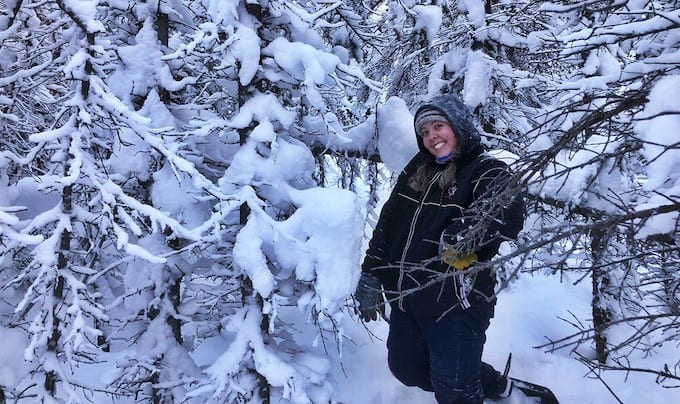
Courchesne was made aware of this opportunity while she was completing her honours research at McGill University. She explains that networking is a huge part of getting to do research in a lab, and she learned about this project by making these connections: “Many graduate students from the lab that I did my research with had projects based on these lynx, hares, squirrels, as well as other staff and personnel being involved in the project over the years.”
At the time she had no idea just how far these connections would take her: “My research used data from the ‘squirrel camp,’ as it is famously called, and so I became quite familiar with the project over the course of two semesters without knowing I’d actually be on location within a year.”
Luckily, even with the pandemic, Courchesne and her team were able to get permission to enter the territory and then respect a two-week quarantine period upon arrival. She explains that there are strict guidelines to be followed at all times, and that it is likely she wouldn’t have had to opportunity to pursue this job had it not been for the pandemic: “We still have to follow all of the COVID guidelines that have become common across Canada, but I am very fortunate to have been able to travel across the country for this job. … Had it not been for the pandemic hindering my ecology job options closer to home, I might not have ever been able to come out here.”
The experience so far has been filled with many life-changing moments for Courchesne. She notes that just getting to live in the mountains has been incredible, along with getting to see the northern lights in person. She also says that the community has been wonderful: “The people here are also very welcoming, and getting to learn about their lifestyle, as drastic of a difference as it is from home at times, is very eye-opening.” Through all of this, though, one favourite part does emerge: “If I had to pick just one, I’d have to say being up close and personal with the lynx. They are a very impressive and beautiful species and getting the opportunity to work with them is pretty surreal.”
Given that the sciences have historically been an extremely male-dominated industry, Courchesne says she is “extremely proud to be a woman in a science-based career and I am thrilled to see that the science realm is reshaping into an environment that is more inclusive, not only for women but for everyone.”
At this time of year when we are celebrating women, she also recognizes that many have had to fight to pave the way for others: “I think I am lucky to be going through my education and establishing my career at a time where it is much more common and accepted for women to be working in science and academia. … I have not experienced as many of the pressures that women before me have undoubtedly had to endure.”
To anyone who is interested in pursuing a similar route, Courchesne has this to say: “The science path is undeniably a tough one, but if you just stick through those tough classes and intense schedules, you’ll find yourself doing something that you love and it will all be worth it!” She emphasizes just how important it is to “never think that you can’t pursue a certain career because you are a woman. If you have a goal in mind, let nothing stop you from reaching it.”