

Yvonne Lewis Langlois
On a chilly morning in March, six men file into the Hinchinbrooke Volunteer Fire Brigade’s station in Athelstan: Donald Grant, retired fire chief; his son Douglas Grant, also a retired fire chief; Sheldon Grant, son of Douglas; Michael Krause, the present fire chief; Paul Lussier, first assistant; and Michael Tully, second assistant. These men, who range in age from 28 to 87, are taking time on a Saturday to talk about their passion: the fire department.
The fire hall is neat and organized. The walls are filled with faded photos of firefighters and firetrucks from generations past. These mementos tell the tale of the rich history of this department, and of the dedicated men who serve here.
The Hinchinbrooke Volunteer Fire Brigade (HVFB) was started in 1963. Donald Grant, who was fire chief for 10 years and is one of the founding members, recalls the fire department’s beginnings: “Our first piece of equipment was a portable pump that was loaded in the back of a truck. Then we got really modern, and we got an old gas tanker truck.” His son, Douglas Grant, adds, “Sometimes it had brakes, sometimes not.” The father chimes in, “I think that they drove it back from Montreal without a licence on it.” Everyone in the room laughs.
Donald Grant says that prior to the creation of the HVFB, the fire-fighting method of the day was “The Bucket Brigade.” If there was a fire, residents called upon their neighbours to come over with buckets to fill with water and douse the blaze. A more effective system was needed.
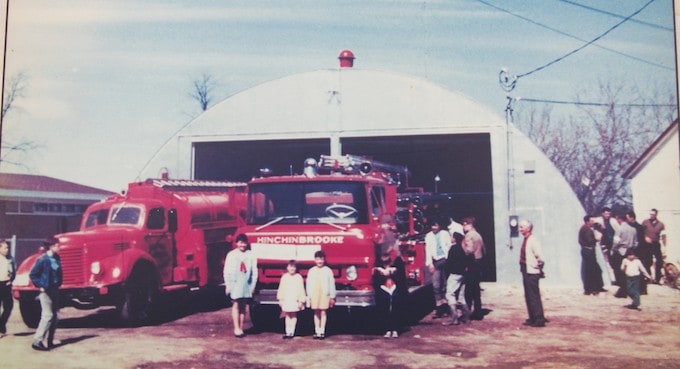
Hinchinbrooke now has two firehouses. In Athelstan, at the station built in 1992-93 to take over from the original smaller one, there’s a pumper truck, a tanker truck, and a utility or rescue truck. In Rockburn, the firehouse boasts a pumper truck, a tanker truck, and a pickup truck with a “brush pack,” which consists of a tank and a light hose and is used for fires that are inaccessible for a larger vehicle.
“The reason the fire station was (first set up) in Athelstan was that most of the manpower was there. But in the early ’70s in Rockburn they realized that they were a long way from the fire department,” Donald Grant
The solution at the time was to park a fire truck in a borrowed garage in Rockburn. Eventually, the firemen themselves built the fire station that stands in that community today.
In the early days of the department, the communication system consisted of four firemen’s wives who operated “fire phones” in their homes. “There always had to be someone with those phones,” Donald Grant remembers. “Each phone had a key that, when turned, would set off the siren at the station. Then the wives would start the phone chain. My wife always said that she liked to have the fire phone there, because it was the only chance that she got to tell a man where to go,” he laughs.
These days, a 911 call goes to Saint-Georges-de-Beauce, Que. In seconds, the call is forwarded via communications by radio and internet. Firefighters receive cellphone texts, pager alerts, landline calls and two-way radio calls.
“The initial call is heard by every fireman in southwestern Quebec in the 10 departments that we work with. Everyone hears everybody,” says Douglas Grant. As they always have their gear with them, all HVFB firefighters who can respond to a call on their territory do so. If they are not needed at the scene, they turn around.
Crews at all other nearby fire departments are at the ready, some often sitting in their stations or in their trucks waiting to go. One department will also cover another’s empty station while they are out fighting a fire. (The other fire departments HVFB cooperates with are those of Godmanchester, Ormstown, Howick, Franklin, Huntingdon, Saint-Anicet, Sainte-Barbe, Saint-Louis-de -Gonzague, Saint-Etienne-de Beauharnois, and Constable, N.Y.)
HVFB covers all of Hinchinbrooke and half of Elgin, while the firefighters of Constable, N.Y., cover the other half of Elgin. They are both part of the mutual aid service that exists between the United States and Canada.
“There is no border for the fire department,” states Douglas Grant. When the HVFB is needed to fight a fire in the U.S., the dispatcher calls customs to let them know that the fire trucks are coming, and they are waved through. Even during the pandemic, calls still come in from the U.S.
Hinchinbrooke’s mutual aid system was based on the American setup: “The U.S. firefighters came down from the States to help us figure out how we were going to set up our own fire department,” says Douglas Grant. “My first training was up there.”
Of the 10 fire departments in southwestern Quebec, HVFB is one of only three that consist completely of volunteers. Except for the 300-hour training course, these firefighters do not receive payment for any time devoted to the department. Sheldon Grant, son of Douglas Grant and grandson of Donald Grant, says, “There is no financial incentive to show up, but we still have 33 guys who love coming and want to come.”

When you pore over the many plaques on the wall, you do notice that many firefighters listed there have the same last names. In total, 21 families have supplied firemen over multiple generations. Although being related to a firefighter is not a prerequisite, “It’s kind of like a second family; it’s a brotherhood,” says Sheldon Grant. He notes that the brigade members often get together outside of the fire department. That brotherhood becomes a tangible thing when you listen to these men talk together.
“You need a lot of dedication in the fire department — dedication to the department and to each of the other firemen,” Donald Grant says emphatically.
Each fire requires a crew approach; for example, multiple firefighters operate each hose. Douglas Grant explains, “If you are going in on a line somewhere, the other guy is dependent on you. The crew that’s going up the stairs is pushing fire ahead of them. It has to go somewhere. It’s got to be coordinated.”
Paul Lussier describes responding to a fire call: “It’s an adrenaline rush. You’ve got to put it out, but you’ve
There are calls that they just don’t forget. Douglas Grant remembers when the ice storm hit. It was his first day as fire chief, and he received 200 calls in three days.
They all remember a house fire on the Boyd Settlement that killed three children. “I can still remember the kids’ names,” says Michael Krause. “You never forget it,” they all say together.
Chief Krause sums up the HVFB best. “There was a lot of family pride. A lot of local people proud of what they had built from nothing, and it has just spanned the generations, and it’s carried on in the people here now who have that same pride.”
1 Comment
Kudos to the HVFB. My husband Richard Panunzio was a volunteer in the department for 17 yrs.