

Sarah Rennie
Businesses that are still thriving after nearly a century and a half are few and far between. B. Brunet Monuments is one of these, having been first established in Ormstown in 1876. Adele Brunet represents the fourth generation of Brunets to run the business, but “we always say it has been in the family for five,” she says, as the company has been passed down through five owners since it began.
Brunet’s great-grandfather’s eldest brother, Joseph, moved to Ormstown from Saint-Louis-de-Gonzague to open his workshop after completing an apprenticeship as a stone cutter in Barre, Vt. He hand-crafted monuments from sandstone, granite, and most often, marble – all with a hammer and chisel.
The business prospered and was relocated from its original spot to a larger area in order to accommodate surfacing and polishing machinery. It hasn’t moved since and stands there to this day.
At the time of the relocation, Joseph was joined by his younger brother Gonzague, who would go on to purchase the business in 1890 when his brother decided to establish a new shop on Côte-des-Neiges Road in Montreal.
At the turn of the century, when granite replaced marble as a more durable option for stones, it was brought to the shop in slabs or smaller pieces and was finished on site. Shipments to Ormstown arrived by rail and all stone was unloaded onto wagons by hand, using wooden or iron rollers and crow bars. It was then drawn to the shop by horse.
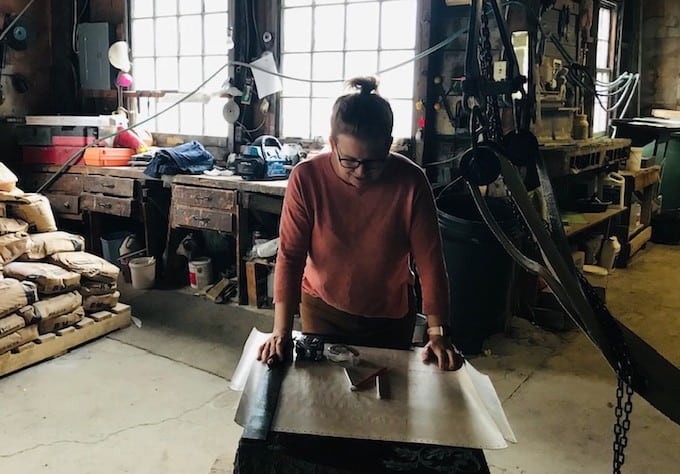
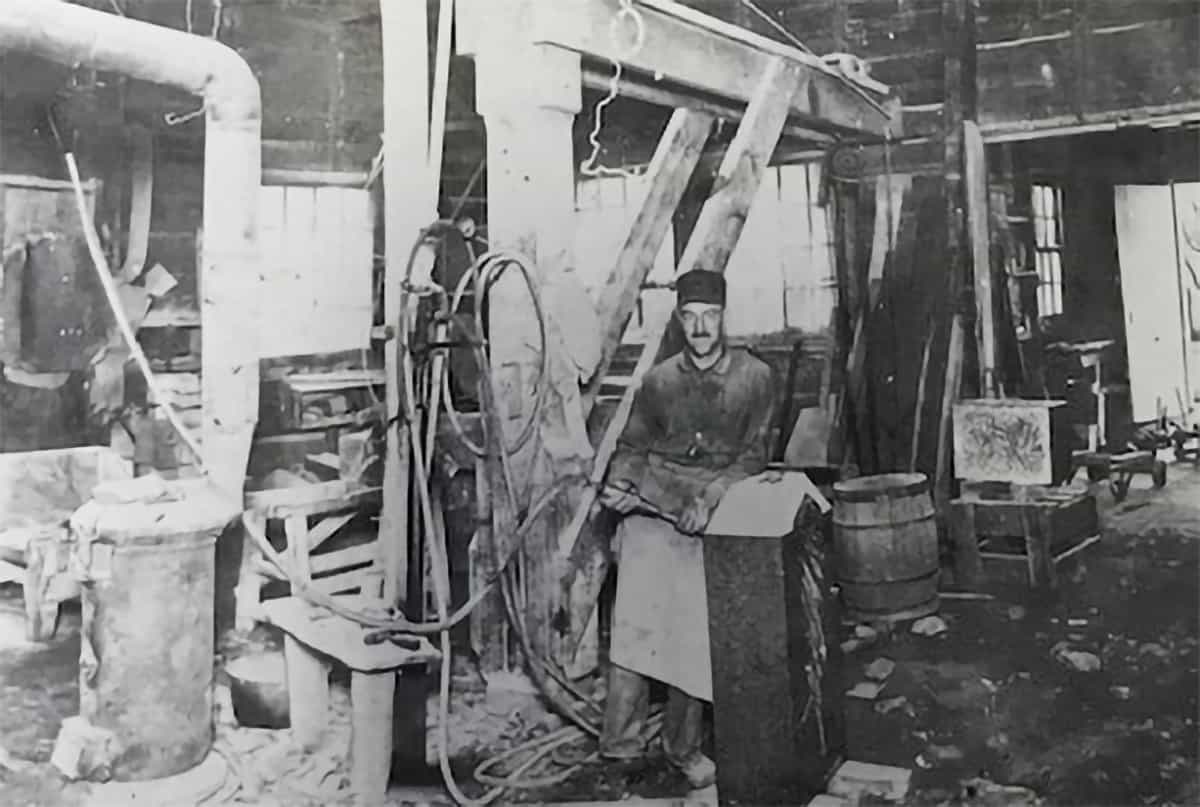
The shop was taken over by Gonzague’s oldest son, Armand, in the late 1920s. All the monuments were entirely fabricated in the shop into the 1940s. The Brunets were still hand lettering into the 1960s, when sandblasting technology was introduced. “You had to be sure your lines were straight, and your centre was centred,” says Brunet, noting how a steady hand runs in her family. Her father, Bernard, joined the family business in 1960 and took over in 1968.
Brunet says that initially she never saw herself taking over the helm at B. Brunet Monuments. She started helping her father one day a week and came to discover that she really enjoyed the work. She considers herself fortunate to have been mentored by her father and to have spent years working with her uncle Gilles
“It is a really nice artistic outlet,” she says of the creative side to the business. “You can make something really personal.” The stones are no longer shaped in the workshop, but the design work is all done in-house.
She also appreciates that the work keeps her busy. “For the eight months that I am here, I’m running,” she says, mentioning that while the winter break offers her a chance to refuel, it is always nice to come back to the shop in the spring.
Having been back at work for a few weeks now, Brunet reflects that 2020 was a strange year. “There were so few funerals,” she says, regarding the public health restrictions that continue to limit private gatherings to 25 family members.
Another stand-out of this past year, she observes, was the number of monuments that were sold to couples. “COVID seems to have made people realize certain things,” says Brunet, referring to the fact that the pandemic brings us all a touch closer to recognizing how quickly life can change. However, “It’s a nicer feeling,” she says of working with people who are selecting their own monuments. “It is not as sad or emotional.”
For Brunet, working with families during delicate times is a privilege. “You hear about a lot of amazing people,” she says, admitting that while it can be a difficult job at times, it feels good to be able to provide this service. “People come and they touch the name of the person who passed away,” she says, describing the innate reaction people seem to have when they first see their finished stone.
“I really don’t know how we are going to memorialize people in the future,” Brunet says, reflecting on the many ways in which the industry has evolved over the near century and a half that her family’s business has been in existence. “It’s a long time,” she admits, with pride. “But if it ends with me, that’s fine.”