

Holly Dressel
Previously, The Gleaner mentioned Quebec’s Law 59, now under consideration, that gives occupational disability status (in some cases) to farmers stricken with Parkinson’s disease because of the disease’s connection with the pesticides they use. The same law will try to do more: protect women from violence, deal with widespread lead poisoning from old pipes, address work-related PTSD and, very importantly for our area, recognize Lyme disease as “eligible for the presumption of occupational disease”— which means sufferers could receive more government help.
Claire IsaBelle, MNA for Huntingdon, wrote a short précis of the law proposed by Jean Boulet, Quebec’s minister of labour, employment and social solidarity, for the April 28 issue of La Voix Régionale. She says the Quebec government heard from “more than 30 groups and professionals” and studied over 70 briefs before making Lyme part of this new official aid.
IsaBelle says, “Why is [PL 59] so important and beneficial to our workers? Because from the outset, these diseases are presumed to exist, which means that people who work in the agricultural sector, or others who suffer from one of these diseases, have a reduced burden of proof.” The use of the word “presumed” seems surprising given Lyme’s high incidence out here, but this definition is still part of some very important progress.
We see many notices warning of tick diseases, and few cat or dog owners are unaware of the risks to pets. We hear about (and some have received) a single, supposedly preventative dose of doxycycline you can get from a pharmacist if you have a rash, that may to protect you. Given all that, we might believe that the simple acceptance of the disease’s existence is no longer an issue in Quebec.
If you also know people who have been stricken with it, however, you’ll know tests and treatment are neither automatic nor easy to obtain. This appears largely to be because its high prevalence in southern Quebec, along with its chances of causing long-term disability even after antibiotic treatment, do not yet seem to be clearly understood by the Canadian medical system – even though both testing and treatment are far better in the EU and the US, where contraction of the disease has increased as well.
Just one example from last November is indicative of many people’s experience in trying to get diagnosed. Thea Toole’s 13-yearold son started to have trouble with one knee; it was so swollen he couldn’t bend it. When he spiked a fever, she rushed him to the Barrie Memorial Hospital in Ormstown and eventually, after 24 hours in a Valleyfield hospital, he was admitted to the Children’s Hospital in Montreal. During all this time, Toole, whose farm is in a Lyme hotspot near Saint-Chrysostome, repeatedly asked the doctors to test for Lyme, as her son’s symptoms were very similar to those of a friend who who had recently had it. She says, “The care was excellent in general, but all the doctors had a strong resistance to considering Lyme.” The doctors spent days on other tests, trying to treat for a bone infection and then calling in specialists.
Since nothing seemed to help, after seven days in the Children’s the medical team finally sent off a blood sample and began to treat the boy for Late Stage Lyme or Lyme Arthritis. Toole says, “Two days after they finally started treatment, they received the results of his Lyme test, which was positive.” Her son was sent home with a prescription for antibiotics and anti-inflammatories, which he took for several months. “But,” she adds, “The arthritis did not fully resolve until April, after a steroid injection into the joint.” The family now worries about recurrences and new symptoms, both of which can happen to Lyme patients, plus a new summer of being exposed to ticks.
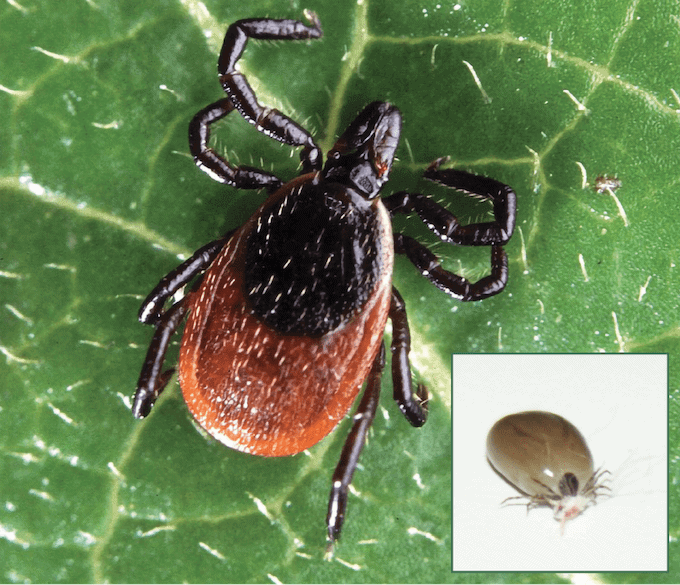
Canada that can transmit Lyme disease PHOTO Scott Bauer United States Department of AgricultureWikipedia Inset an engorged tick recently taken off a cat in
Hinchinbrooke PHOTO Chantal Hortop
There is a Lyme vaccine in the works. Valneva, a French company which has produced current on-themarket vaccines against cholera and Japanese encephalitis, is being funded by Pfizer to do a Phase 2 study on the viability of their Lyme vaccine in children and adults from 5-67, using subjects from the US northeast who have recovered from a Lyme episode.
If all goes well, the vaccine will move to Phase 3 in 2022 and hopefully will get fast-tracked for general use, perhaps by 2023. That’s still a long time away. We all remember how, with great injections of grants, companies like Pfizer and AstraZeneca were able to come up with COVID-19 vaccines in record time, but that’s not always the case, and this is the second try for Lyme.
A nearly 80 per cent-effective Lyme vaccine was developed by SmithKline Beecham and administered to 1.5 million people in the late 1990s. However, a situation similar to AstraZeneca’s and Johnson & Johnson’s current woes developed. A very rare incidence of arthritic symptoms (66 cases in 1.5 million) was linked to this vaccine, and, like AstraZeneca’s blood clots, this side effect possibly had other risk components, although both so far share too low an incidence to be sure.
At the time, the media became very excited about what was, as it turned out, an arthritis incidence rate no higher than what would naturally occur in a population that size. This was also the era when many people blamed vaccines for the increasing incidence of conditions like autism and ADHD in children (which we are now learning are most likely tied to industrial chemicals) [https:// www.ncbi.nlm.nih.gov/pmc/ articles/PMC2870557/]. In any case, this effective vaccine was withdrawn, and development was left to languish until Valneva took it up again, making the news with their first successful clinical trials in 2020.
Even if the danger of Lyme disease gets some official recognition when Bill 59 becomes law, IsaBelle notes that “Of course, certain conditions must be met” for farmers or rural workers to obtain workers’ compensation if they suffer from either Lyme or Parkinson’s. That means getting compensation may not be very easy either. Still, as IsaBelle says, “We can rejoice in the recognition of these two diseases,” now officially being seen by our government as a serious problem for rural populations, which will hopefully lead to better diagnosis and more prompt and complete treatments.