

The day when people will be able to swim in the Chateauguay River without risking dermatitis may not be far off.
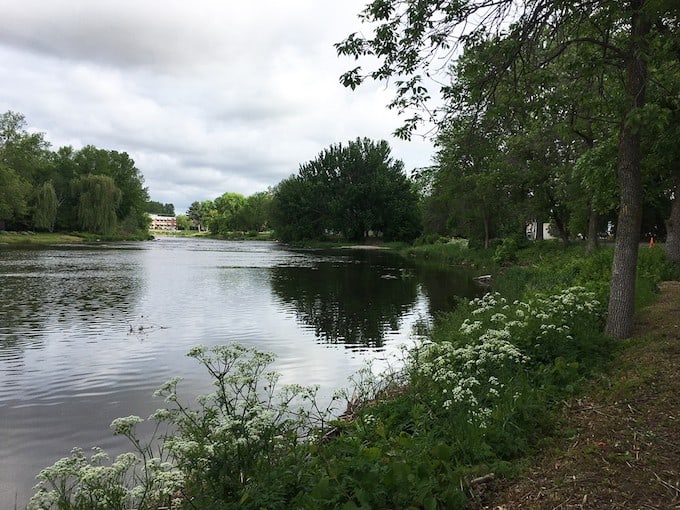
“A myth we need to correct is [to make people understand] that the brownish colour of the water is not an indicator of pollution. This colour is due to the colour of the soil,” says Félix Blackburn, the executive director for the Société de conservation et d’aménagement des bassins versants de la zone Châteauguay (SCABRIC).
The SCABRIC has recently partnered with the Fondation Rivières to propose a project to highlight the potential for swimming. “The concentration of coliforms is the main factor that can restrict swimming,” says Blackburn.
A new technology, the ColiMinder, makes it possible to monitor the concentration of coliform bacteria in the water online and in real time. “Samples can be taken every four hours and the results of the analysis are available within 15 minutes,” says Blackburn. Using this new technology, the SCABRIC and the Fondation Rivières would like to “construct an accurate assessment of the bacteriological quality of the water of the Chateauguay River to evaluate the potential of opening beaches in Huntingdon, Ormstown, Sainte-Martine and Chateauguay.”
A ColiMinder would be installed at the drinking water intake in Huntingdon. Measurements would be taken on a regular basis and transmitted in real time to researchers from the Université TÉLUQ and the Université de Montréal, who are conducting a study on pesticides in the river. The SCABRIC would also take water samples at the proposed sites for beaches. “Currently, we don’t know if we can swim in the river. We’ll have the tools to find out,” says Blackburn.
In the event of a sewage overflow, for example, Blackburn suggests that the ColMinder would be able to tell within as little as 15 minutes if the water of the river is acceptable for swimming again.
There are three sites under consideration for swimming in Chateauguay, including Seers Park, the Parc de la Commune, and Laberge Park. Another site in Sainte-Martine at the base of the Dunn dam is also being considered.
Blackburn says he is “excited” about the project after tests conducted on the Assomption River in the Lanaudière region proved conclusive. “The Assomption River is almost identical to the Chateauguay in terms of village nuclei and farmland,” he says. Following a bacteriological analysis conducted by the Fondation Rivières, “the Town of L’Assomption is considering opening a beach!” exclaims Blackburn. “We can only hope for equally positive results for the Chateauguay River,” he says.
The cost associated with the project is $60,000. The two organizations have secured $20,000 and are looking for support to meet their budget. They are currently taking steps, particularly with different municipalities, in order to move the project forward. “We can’t pass this up. The project will provide a lot of knowledge about the quality of our river water,” says Blackburn.