

After surviving a close call in late April, local orchards suffered major damages from frost this past weekend when delicate fruitlets were exposed to three consecutive nights of freezing temperatures.
“No one really expected frost like that,” says Tim Petch of Petch Orchards in Hemmingford, who admits to having been quite shocked by the sudden temperature drop. Petch says he first became aware something was off on Saturday morning. “I noticed the young shoots were drooping. Then I was looking at the apple clusters, and they were looking a little off-colour,” he says, noting some of the fruitlets were feeling mushy. “I opened them up and they were brown inside. Even in the ones that weren’t mushy, the seeds were brown, which means they were frozen.” Petch estimates that up to 50 per cent of the year’s harvest may already be lost.
Laurie Ann Prevost, who owns Rockburn Orchards in Hinchinbrooke, says she walked the entire orchard Saturday morning and could tell just by looking at the fruitlets that they had frozen. Some were already purple or black and shriveled. The temperature in Rockburn dropped to between -1 and -3 degrees C for a few hours overnight and went below zero again on Saturday night. She estimates upwards of 90 per cent of her apples have been lost.
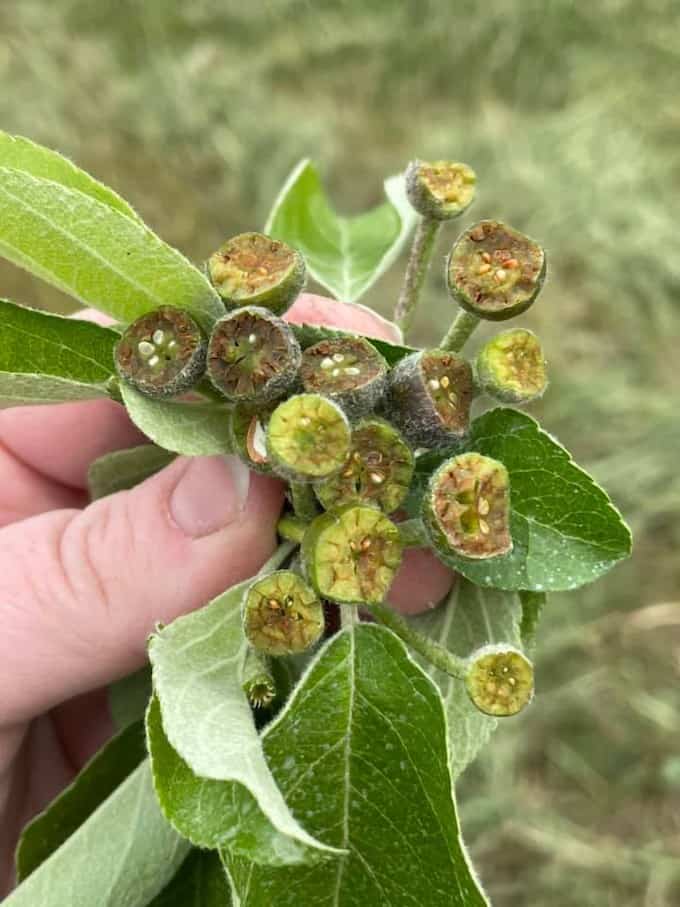
“I have called the insurers and they will come assess the damage,” she says. “From what I scouted, I’d say half are completely brown and the other half are less brown but still have brown seeds,” says Prevost, while admitting she is not sure whether the fruit with brown seeds will continue to grow or simply rot and drop from the trees. “Any sign of browning is not good,” she laments.
Frost-damaged apples may still mature, but they tend to be misshapen and have very little storing capacity, explains Jeff Blair of Blair Orchards in Franklin. “It always gets a little colder in Rockburn than in Franklin,” he says, while reporting that despite substantial damage in the lower pockets of the orchard, his is “not a complete loss by any means.”
Blair notes that much of his orchards are planted with semi-dwarf trees, and the damage has been limited to their lower halves. “The apples are more susceptible in the fruitlet stage than when they are in full bloom,” he notes, acknowledging there is always a risk of frost at this delicate stage of fruit development.
“We had a similar freeze like this in the mid 1980s. It was in early June that year, so it does occur from time to time,” says Fred Stevenson of Stevenson Orchards in Hinchinbrooke. “Right now, it’s going to be hard to determine the extent of the damage,” he says, but asserts that “There will be apples this fall.”
Apple producers were not the only ones hard hit by the chilly weekend weather. Photos of damaged fruit and vegetable plants, asparagus, vineyards, and even cornfields began circulating on social media over the weekend. Valley farmers and gardeners now have little choice but to wait to see whether plants recover from the frost and whether Mother Nature has any curve balls left to pitch before the end of an already stressful season.