

Concerns revolving around climate change seem to be more and more pressing each day. And the reality is, we in the Valley are not immune to the effects of the climate crisis on the environment and agriculture. Since 2001, Chinook Wind Machines, a company in Hemmingford, has been providing frost-protection equipment to farmers to help prevent damage by unexpected low temperatures.
Nicholas Maniadakis currently runs the Chinook Wind Machine dealership in Hemmingford. In 2001, his father purchased a machine for his own organic apple orchard, and at that time he started selling machines to other Quebec farmers as well. Maniadakis would often accompany his father to different installations, and he eventually became a sales representative for the family business. It was in 2018 that he took over the dealership entirely, and so far, 2020 and 2021 have been its biggest years to date.
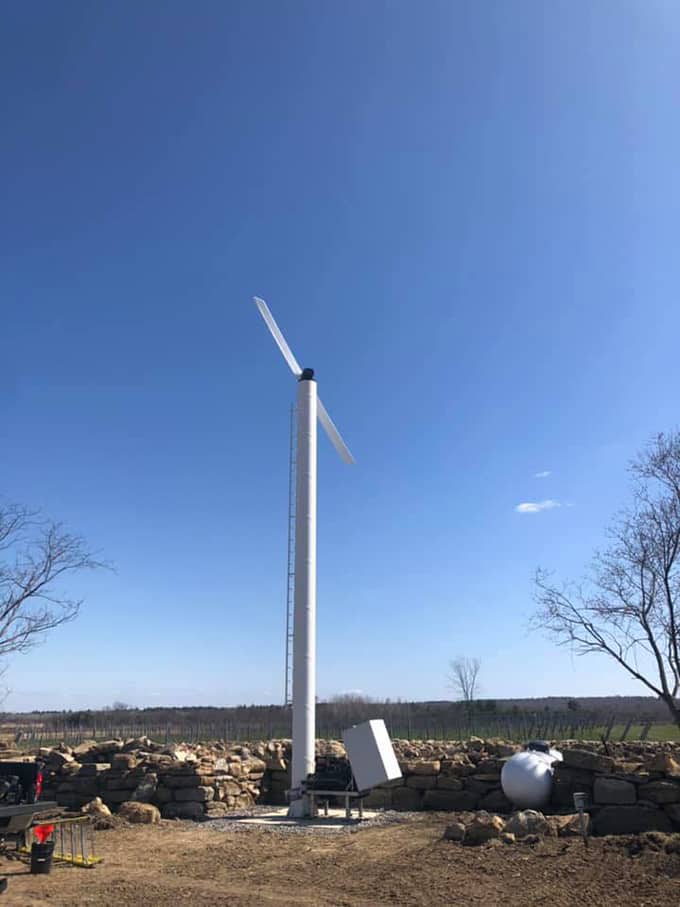
Chinook Wind Machines help to offset some of the unpredictable effects of climate change. The purpose of the fan-like machine is to bring down warm air during any extreme frosts that are potentially fatal to crops. Maniadakis explains: “The theory behind this fan is that it will pull hot air out of the sky during a frost. … there is an inversion layer when we have a frost; the hot air will rise because the cold air is heavier and [displaces] it.” The warm air can rise to 150 feet – sometimes even higher.
The machines run approximately every four minutes, blowing the warmer air downwards which ensures that plant buds remain viable. “The wind machine has an angled gearbox on it, and it will go suck the hot air out of the sky and blow it down on the crops. Our Chinook Wind Machines cover 450 feet in every direction or 900 feet in diameter.” They can run throughout the night if necessary, to ensure the safety of the crop.
The company is available for support 24 hours a day, seven days a week. Maniadakis says, “We pride ourselves on being able to support the equipment, not just install it [and] then disappear. These machines only run at night, so someone needs to be there in case anything happens – even if it’s as simple as a dead battery, which it usually is.” The thing about a frost machine is that when it’s time to use it, the need is immediate. If it isn’t working, a crop can be lost, so around-the-clock support is essential.
The environmental impact of one of these machines is quite small. Maniadakis explains that “The machines run on propane, so they’re a lot safer; they’re a cleaner-burning technology.” Besides slight emissions, they produce a little bit of noise pollution, but they generally only run two or three nights per year, and only for about five hours at a time, so the disruption is minimal.
In comparison, some people use helicopters to combat frost, which has a much more negative effect on the environment. “Some people bring in helicopters to try to recreate what a wind machine does, but those have, I’m sure, a much greater impact on everyone around them and the environment. Our wind machine does not burn nearly as much fuel as a helicopter does.”
The need for the machines has grown, and Maniadakis says that they are “battling climate change a little bit. We’re helping growers be able to actually have a crop. In the past, it didn’t ‘frost’ as much. As of late we’ve been getting more major frosts and small ones and [some] earlier in the season.” With the increased occurrence of frost in the recent past, Chinook has been expanding at a quicker rate. Following this spring’s freeze, the company installed about 15 machines, and it has five or six more going in this year. It also has 15 more in stock, ready for next year.
These machines were originally invented to protect apple orchards; however, in the Valley they have mainly been used to protect vineyards. For example, the Aux Volets Noirs vineyard in Très-Saint-Sacrement installed one this year. The goal in the future is to expand into the apple orchards in the region, to help protect those crops as well.