

Callan Forrester and Rachel Patenaude
The Valley was saddened by the recent news that a Huntingdon cultural landmark, Grove Hall, would be closing its curtains for good after owners Tina and Mark Bye announced they had sold the building. Grove Hall was a hotspot for local theatre, concerts, weddings, and countless community events.
It is also where the Rural Arts Project was based, a not-for-profit organization run by the Byes that aimed to make community arts more accessible, with a particular focus on arts education. Grove Hall was an inclusive place that encouraged all artistic disciplines, and where anyone was welcome.
Through the various programs offered, people of all ages found a sense of purpose there, whether they performed with Mark and Tina for a few months or a few decades. Though the Rural Arts Project itself had been running for less than a decade, some people such as Grove Hall veteran Howard Welburn have been working with Mark and Tina since high school, and will be sad to see the end of this era.
Welburn explains that he’s known Mark since they “premiered a two-man play together at the Rockburn Church Hall in the early ’80s.” He has been performing on the Grove Hall stage since their production of Lend Me A Tenor in 2015, and reflects that Grove Hall was a judgment-free place where all people could gather and where young artists could begin their performance careers.
“The Rural Arts Project has enriched our lives. We’ve been treated to and spoiled by all the shows that have highlighted local talent,” he says. “It has been fulfilling to see shy, and not so shy, young people blossom with self-confidence.”
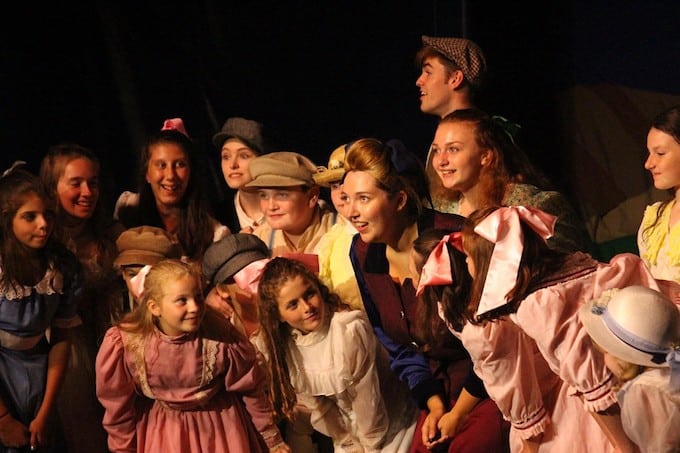
One of these talented young people is Dakota Adams, a relatively new but nonetheless celebrated member of the Grove Hall family, who has been performing with the group since 2018 when she was cast as one of the two alternating “Annes” in the Anne of Green Gables tent tour. Adams explains how important Grove Hall has been for her in her formative years: “I’m glad that I got to grow up with it. Especially at the age that I was. It impacted my life tremendously, hanging out with the right people; I’m so grateful for that.”
She goes on to explain that this kind of cultural programming is not often found in small communities, saying, “I always thought, ‘It sucks that I grew up in such a small town, I won’t get to have any of these opportunities,’ but this was probably the best opportunity I could have gotten.”
All were welcome to the activities at Grove Hall, and many of those who took part did so with their families. “Tina and Mark allowed my entire family to be involved, which was such a bonding experience for us,” says Wendy Ingram, who performed in Anne of Green Gables along with her four daughters. “It gave my family the opportunity to belong to something special,” she says. “Not only did we get to participate in a couple of fantastic productions, but we also had the opportunity to meet some amazingly talented people and develop lasting friendships.”
Jeannie Rosenberg, a retired doctor who also acted and sang in Anne of Green Gables, frequented Grove Hall often as a patron, and spoke of the importance of having a centre for the arts in a town such as Huntingdon. “I thought it was extraordinary that Huntingdon had so much culture,” she says, mentioning how wonderful it was that Grove Hall hosted Repercussion Theatre’s Shakespeare in the Park tour, as well as facilitating many community events. “You make a lot of friends; you broaden your horizons. It adds to your life, interacting with all these other people, [having] all this energy around you, which you forget when you get old,” Rosenberg says with a laugh.
Many who graced the stage in Grove Hall’s productions were also involved in summer camps and backstage work, such as Katherine McKay, a college student who has been participating in projects at the hall for years. “Before, I was a shy kid, and I didn’t know where I belonged. It was a great way for people to find belonging, and experience new things,” she says. McKay spoke about the importance of having such a space for the community to come together and experiment creatively, and how even in the Byes’ absence, she believes the creative spirit will remain. “They’ll be missed. I’m so thankful that they opened my eyes to something like this,” she says.
Welburn summarizes by recounting an example of the most important quality of the Grove Hall performing community: “We worked with a gentleman who has been performing professionally for many years, who told us that the thing that struck him the most (about the group) was the fact that everyone checked their egos at the door, and we all pulled for each other to do our best.” The lasting impact of Grove Hall and the Rural Arts Project is that sense of creative unity, and the belief in the importance of community connection through the arts. The community is incredibly grateful for the legacy being left behind.
Editor’s note: Both of this story’s reporters also have fond memories of taking part in productions over the years at Grove Hall.