

This past August, the Chateauguay Valley Career Education Centre welcomed eight students from Kahnawà:ke through a partnership with the Kahnawà:ke Economic Development Commission (KEDC) and the Food Security Working Group.
The students in the Kahnawà:ke cohort are studying in the Horticulture and Garden Centre Operations program being run out of the Huntingdon campus, which is also known as the Huntingdon Adult Education and Community Centre (HAECC). The goal of the partnership is to educate, provide training, and promote food sovereignty by growing food in a traditional manner. And while adapting the program has proven to be challenging at times, the inclusion of this cohort has allowed the horticulture department to grow in meaningful new ways.
The teachers have been working since before the launch of the program to frame some of their lessons around specific needs within the community. “It is a work in progress,” says department head Deborah Dohmen, but she says the staff were on board from the start and are willing and excited to incorporate what they can into their teaching. And, she says, the teachers are very open to sharing. “We will be able to learn more from each other and this will help build a bank of knowledge that we will be able to use in the future,” she says.
For Derek Stacey, the centre director for CVCEC and HAECC, the benefits from this initiative will flow both ways. “One of the beautiful things about adult education is that we are able to learn from the students,” he says. “They come with a lifetime of experience and it’s important to respect that.”
He says he hopes the partnership with KEDC will continue. The program has the full support of the New Frontiers School Board (NFSB), which has a long history of collaboration with Kahnawà:ke in vocational training. “We are very excited about this horticulture partnership,” says NFSB’s director general, Rob Buttars, who is also looking forward to the surprise opportunities it will provide to all students.
Tree planting
One such opportunity took place on October 22, when horticulture students were invited to participate in a tree-planting initiative in Kahnawà:ke. Julie Delisle, the Environmental Education liason with the Kahnawà:ke Environment Protection Office (KEPO), reached out to invite students to participate in the Há’o Tewaiéntho! Let’s Plant! initiative, which aimed to plant 450 indigenous trees and shrubs across the community.
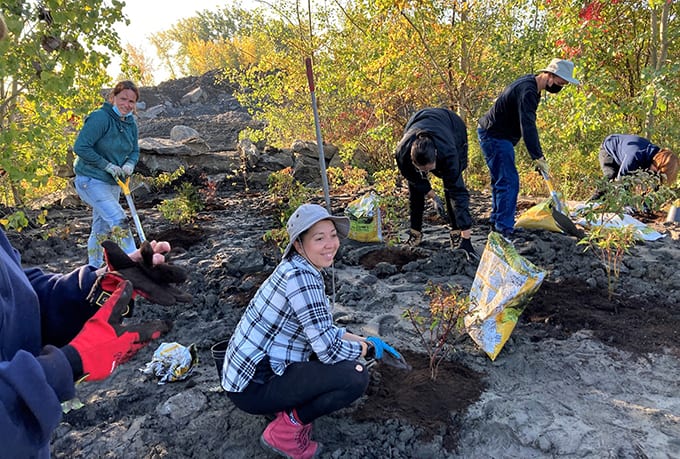
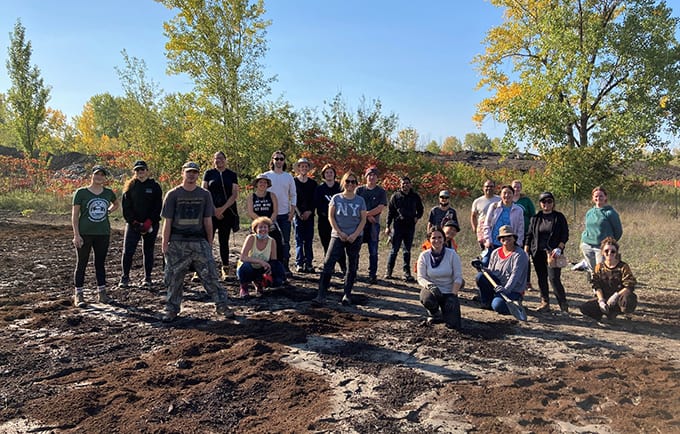
“The timing was right, and we could have students involved,” says Dohmen of the off-site work.
“The students were enthusiastic and eager to help out in any way they could,” says Marina Gosselin, an environmental projects coordinator focused on climate change with KEPO. The students planted around 80 trees on the final day of the initiative, in a reclaimed area on Tekakwitha island that KEPO is working to restore. Gosselin says the students were interested in learning about this process and why this area had been selected for planting.
The focus of the initiative was to plant trees in areas around Kahnawà:ke referred to as “hot zones”. The targeted areas were identified on maps made from Landsat 8 satellite imagery which showed surface temperatures. “With these maps, we were able to see which areas in the community are consistently hotter, which helped guide our planting efforts,” explains Gosselin.
The trees will capture and store carbon emissions while also providing shade to cool these areas, which is one way the community is addressing climate change and adapting to expected impacts such as higher average temperatures and heat waves.
“For the students, it was a really great activity,” says Dohmen, pointing out how the experience of planting the trees helped students to make connections between classroom learning and practical outdoor application. “A cornerstone of what we talk about is sustainability,” she says.
For Stacey, the students’ participation in such an activity reinforces his conviction that the adult and vocational programs are not cast in stone. There are ministry requirements to be met, “but if we can make them better, that’s where we can explore and have fun.”