

Covey Hill is home to various at-risk species of salamanders and birds who now have allies in several local fruit producers.
Quebec’s only occurrence of the Allegheny Mountain dusky salamander, as well as spring salamanders and northern dusky salamanders, all frequent the streams running through the Covey Hill region. The area is also home to bobolink and eastern meadowlark birds, which makes it especially important in terms of conservation efforts.
The Nature Conservancy of Canada (NCC) is now working with growers in Franklin and Havelock to reduce the impacts of apple production on these endangered species, using novel tools and innovative practices.
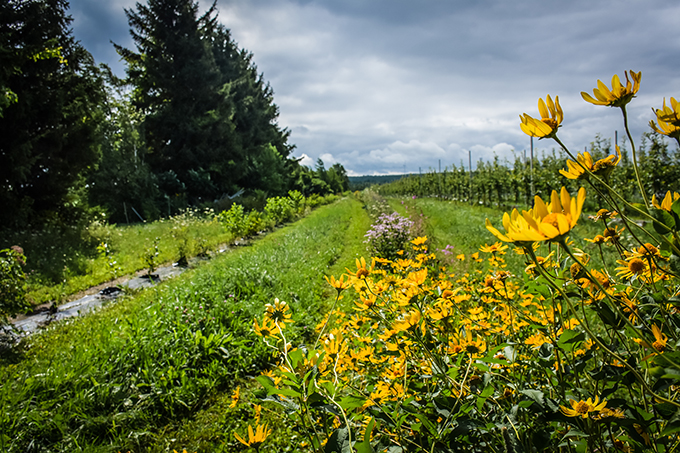
The NCC partnered with the Ministère de l’Agriculture, des Pêcheries et de l’Alimentation (MAPAQ) and agronomists already working with apple producers to create a tool kit that provides options for implementing agri-environmental practices in orchards. These options include the creation of windbreaks, flower islands, and riparian buffer strips, as well as bird-nesting boxes and bat dormitories.
The different options are designed to improve biodiversity in area orchards, which will make them more resilient to disturbances such as pests and climate change. These practices will encourage beneficial insects as well as insectivores such as the golden-winged warbler, a bird species threatened in Quebec, as well as little brown bats and eastern whip-poor-will birds. Apple trees will also benefit from the increased presence of pollinators.
To date, the NCC has recruited five apple growers to the project, where three have implemented measures in their orchards to promote nine different species at risk. The businesses involved include the Vergers du Château Albert, Vergers Leahy, and Vergers Pomibec inc. in Franklin, as well as the Vergers Écologiques Philion in Hemmingford.
“The apple orchards of Quebec’s Haut-Saint-Laurent region have become essential partners in the protection of salamanders and field birds,” says the federal minister of environment and climate change, Steven Guilbeault.
The project has received support from the Canada Nature Fund, as part of the Priority Places for Species at Risk initiative, as well as provincial support through the Accélérer la conservation dans le sud du Québec (ACSQ) program and the Fondation de la faune du Québec.
“We are proud to be working together to maintain a favorable environment for vulnerable species,” says Chantal Cloutier, a project manager with NCC, who credits the collaboration with apple growers on Covey Hill with creating more resilient and environmentally friendly orchards.
Apple growers have also been able to benefit from the Biodiversité aux champs program, which recognizes the actions taken by producers to promote biodiversity in their fields while encouraging others to follow suit in adopting more environmentally friendly practices.
In 2023, Les Vergers du Château Albert became the first business to be receive gold-level certification under the Biodiversité aux champs program. (SR)