

Chantal Hortop
There is a greenhouse attached to Room 228 on the upper floor of Chateauguay Valley Regional High School which has gone largely unused for a number of years. Though CVR is currently lying dormant due to COVID-19, before its temporary closure the school’s Greenhouse Club had been steadily growing, both in Room 228 and in the school’s outdoor spaces.
CVR teacher Brandon Borland explains that the greenhouse’s revival began when fellow teachers Keith Webster and Georgios Tsoulfas began bringing their science classes to the space to see what they might be able to grow. From there, the club formed “partially out of the necessity of maintaining the plants,” Borland says, and they “found an old wooden sign painted with care by some former student group saying ‘Greenhouse Club’ – the students just hung it up again and got to work.”
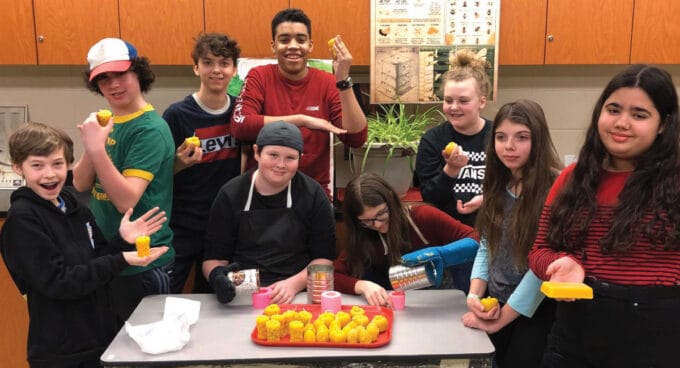
A dozen or so students volunteer regularly to water, fertilize and deal with compost, along with working on various special projects. One of these projects is the school’s beehive, which, apart from the tangible by-products, is a fascinating learning opportunity for all those involved: “the honeybee is about as rich a pedagogical resource as has ever existed,” Borland says.
The produce being generated by the club has been used to supply the “Grab and Go” program, which offers up free freshly prepared food at breakfast and lunchtime for anyone who needs it. The school’s cooking classes also benefit from the steady supply of (very) locally grown food, and in this way students “get to see all stages of the food production cycle … from seed to plate,” Borland says, adding that last year he had “these excited youths [running] their creations up to my class for me to try.”
This enthusiasm has been present in the greenhouses as well as in the kitchen, Borland says. “It doesn’t matter who you are, everybody gets a little thrill when they see something they planted sprout up for the first time.” Fellow teacher Georgios Tsoulfas says, “every student who starts [getting involved in the project] is another cycle at the school,” with each cycle building on the last with great promise for the future of the project. Borland has a similarly positive view of the future, saying “thanks to our community’s agricultural disposition, our large campus and our enthusiastic students, we plan to make these ‘green’ projects synonymous with CVR.”