

Sarah Rennie
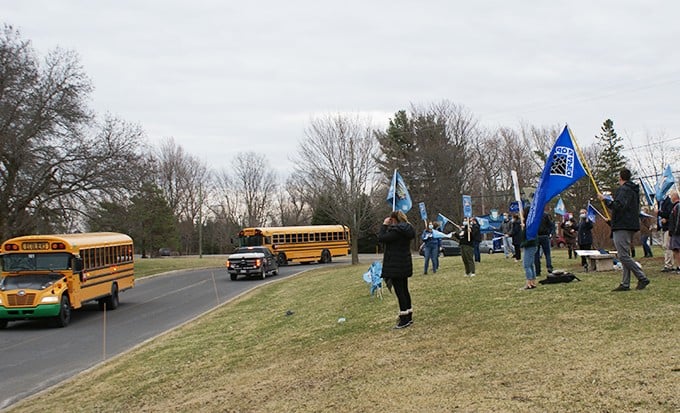
Teachers at New Frontiers School Board (NFSB) elementary and secondary schools as well as centres will join with the 73,000 members of the Centrale des syndicats du Québec in walking off the job as of midnight on April 14. The teachers will return to their posts at 9:30 a.m.
An attempt by the government to issue an injunction to stop the work action was rejected by a Quebec Superior Court on Monday. The court ruled such a decision was within the jurisdiction of the Quebec labour tribunal, and that it would not intervene. As such, the innovative tactic will see a 90-minute to two-hour delayed start to the day at all NFSB schools and centres.
Transportation for elementary school students will be delayed by up to two hours, while students at Howard S. Billings and Chateauguay Valley Regional High School students will move to online learning for the day. Students attending adult vocational and education centres will have a blend of online and in-person learning, depending on the program. The school day will end at the usual time.
“We made the decision to operate elementary schools with a late start because we were able to organize transportation and this would support parents with young children,” says NFSB Director General Rob Buttars. “This was not possible for our secondary students,” he confirms.
The day will play out in the same way at the Centre de services scolaire de la Vallée-des-Tisserands, with elementary students attending classes in person, secondary students learning online, and classes at the adult level taking place either in person or online, depending on the program.
Return to hybrid learning
As of Monday, April 12, students in Secondary 3, 4, and 5 reverted back to a hybrid learning model, where attendance is in-person every second day. The provincial government backtracked on a plan to see all students at the secondary level return to in-person learning early last week, when it became apparent that the province had entered a third wave of the pandemic driven by more contagious variants of the coronavirus.
The NFSB had already opted for a progressive return to classes, and as such, only Secondary 3 and 4 students returned to in-person classes for a very brief period. The abrupt turn-around caught the school board by surprise, as it continues to grapple with the strain being placed on students and employees by the pandemic. “We do hope that this will be the model maintained for the rest of the school year,” says Buttars, who admits he doesn’t expect the government to understand the planning involved in managing in-person and online learning. “There is a lot of work that has to be done,” he says, before adding resolutely, “and, we will get it done.”