

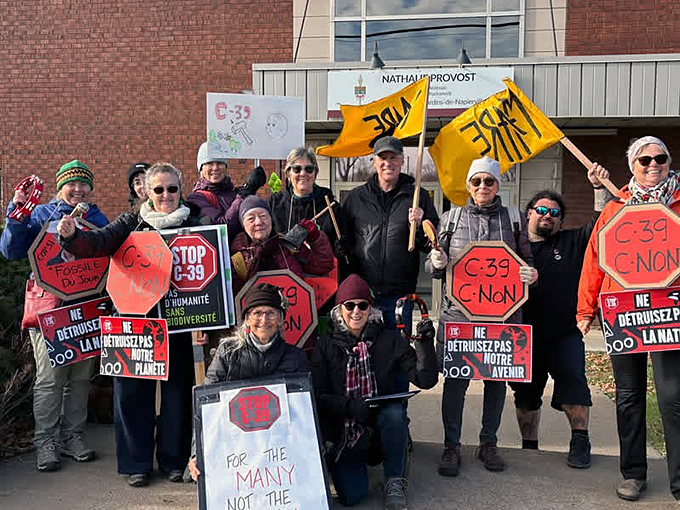
Around 30 people, including several Valley residents, took part in a national day of protest against Bill C-39 outside the constituency office of Châteauguay-Les Jardins-de-Napierville MP and secretary of state for nature, Nathalie Provost, on Nov. 12.
The protest, organized by Mères au front Rive-Sud, was one of 65 demonstrations that took place across the country against the federal government’s omnibus bill, known as the Building Canada Strong Act, which is currently under committee review in the House of Commons.
Also in attendance were representatives from Mères au front – Vaudreuil-Soulanges, the Mouvement d’action régionale en environnement (MARE), and Boisés et écologie Châteauguay (BEC).
Critics of the bill, including those waving signs and chanting in Châteauguay, argue it will weaken environmental protections, limit people’s right to strike, and undermine Indigenous rights.
“Bill C-39 is an attack on what matters most to us and our community. It is an attack on our planet, as it circumvents environmental regulations that protect nature, wildlife, and the climate,” said a representative for Mères au front – Rive-Sud in a post on social media. “For us, above all, it is an infringement on the rights of our children and future generations to live in a healthy environment.”
Provost met with three representatives from the organization ahead of the planned protest on Nov. 11. “It was important for me to hear their concerns directly before the demonstration,” she said, noting the meeting offered a chance to address the issues raising questions over this legislation.
In response to concerns about a potential weakening of environmental protections and community participation, Provost explained that the government wants to speed up the process while maintaining rigorous environmental requirements, including climate impacts and effects on at-risk species.
“Developers need to know what studies to provide and to understand the steps that will lead to a decision. We want to improve this predictability by better coordinating the work of federal authorities,” said Provost.
“My experience with environmental permitting allows me to appreciate the importance of this coordination, as well as that of the analyses needed to protect natural environments,” she added. (SR)